
Our daily experience is not only shaped by calculations and rational decision-making, but is constantly influenced by emotional states. These strongly influence how we interpret what happens and how we respond to situations, both internally and in our relationships. This emotional dimension often remains implicit, yet it is far from secondary, as it shapes our thinking and guides our choices. It is at this level that developing emotional intelligence becomes crucial, as it provides tools to understand and manage what would otherwise remain unclear.
Emotional intelligence as an applied science
Emotional intelligence refers to the ability to recognize, understand and manage emotions in order to use them consciously to shape mental processes and behavior. In this context, Daniel Goleman’s work is a key reference. To fully understand his contribution, it is helpful to recall the origins of this concept. In 1990, Peter Salovey and John D. Mayer introduced the notion of emotional intelligence, defining it as the ability to monitor one’s own and others’ feelings, to distinguish among them, and to use them to guide thinking and action 1.
It is from this scientific formulation of the construct that subsequent cultural developments have emerged. Goleman’s contribution, in particular, makes this topic more accessible and practical, allowing it to move beyond specialist contexts and into everyday life and organizations. In his work, he articulates emotional intelligence into four main domains: self-awareness, self-management, social awareness, and relationship management.
The value of this framework lies in making explicit what would otherwise remain indistinct. This is precisely the key point of Goleman’s work: emotions are not treated as a vague background of experience, but as a force that shapes how we perceive, evaluate, decide and relate to others. Rather than speaking in general terms about emotional maturity or relational sensitivity, Goleman distinguishes different levels of experience and action. Self-awareness is the ability to recognize what one is feeling as it happens, to grasp the emotional tone that accompanies a decision or reaction. Self-management concerns how these emotions are handled and channeled into action. Social awareness shifts attention to others, to the atmosphere in a room, and to the signals that precede or accompany words. Relationship management finally concerns the quality of action: influencing, listening, guiding, managing conflict and working with others.

It is in this sense that the practical relevance of emotional intelligence becomes clear: a more precise and nuanced emotional vocabulary leads to more accurate action. In other words, when we are able to distinguish more clearly what we are experiencing, we also become more capable of processing it and responding appropriately. A few examples are enough to show how this competence manifests across different areas of everyday life. In work and educational contexts, it helps us recognize when a decision stems from clarity and when it is instead driven by haste or a need for control, while also providing a more precise language to identify inner states. In personal life and relationships, it can help us distinguish a judgment from a reaction, or disagreement from irritation, and to recognize the moment when a conversation becomes tense because concern replaces listening. This is particularly relevant in conflict situations, where the ability to recognize and manage emotions is essential for turning tension into a space for understanding: we explored this with a conflict coach in this article and this one. In all these cases, the benefit is not only descriptive but operational: having more accurate ways to describe what we feel allows us to better understand what is happening and, as a result, to act with greater clarity.
Emotional intelligence and Buddhism
From a broader perspective, Goleman’s work also opens up another level of reflection: a dialogue with the Buddhist tradition and contemplative disciplines 2. This dialogue began to take shape in the 1990s through the Mind & Life Institute, an organization created to bring science and contemplative practices into conversation in the study of the mind. In this context, important interdisciplinary meetings have been organized between scientists and meditators on the topic of emotions. In particular, Goleman was involved in an initial meeting focused on the relationship between health and emotions, followed ten years later by a second dialogue on destructive emotions. This latter exchange brought together Western and Buddhist perspectives on when an emotion becomes destructive, that is, when it produces suffering and harm 3 4. At this point, the discussion of emotional intelligence gains further depth, as it becomes connected to the quality of mental states—that is, the conditions of the mind at a given moment, such as openness, closure, clarity or confusion. From this perspective, attention shifts to the potentially destructive effects of these states, which can alter judgment and fuel suffering. In the Buddhist tradition, recognizing and transforming negative emotions lies at the heart of spiritual practice. This is a crucial point: it reveals a meaningful continuity between psychology, an ethics of attention and inner discipline.
The connection with Buddhism requires careful interpretation. The central point is the convergence between two traditions of inquiry: the psychology of emotions, which develops models, competencies and descriptive tools, and a contemplative tradition that for centuries has studied the training of the mind, the origins of afflictive states and the practices for their transformation. From this perspective, the dialogue promoted by the Dalai Lama with scientists and scholars, in which Goleman has played a significant role, has made visible a shared ground: emotions as an object of both knowledge and practice.
Navigating emotions
Within this broader constellation of themes, the Atlas of Emotions also finds its place: a project based on an idea by the Dalai Lama and created by psychologist Paul Ekman together with researcher Eve Ekman. Its aim is to build a true “map of emotions to develop a calm mind,” designed as an interactive tool to expand emotional vocabulary and better understand triggers, inner states, and possible responses. In relation to emotional intelligence, the value of the Atlas lies in its ability to make the observation of emotions more precise. It invites us to grasp their dynamics with greater nuance, from early signals to possible points of intervention.
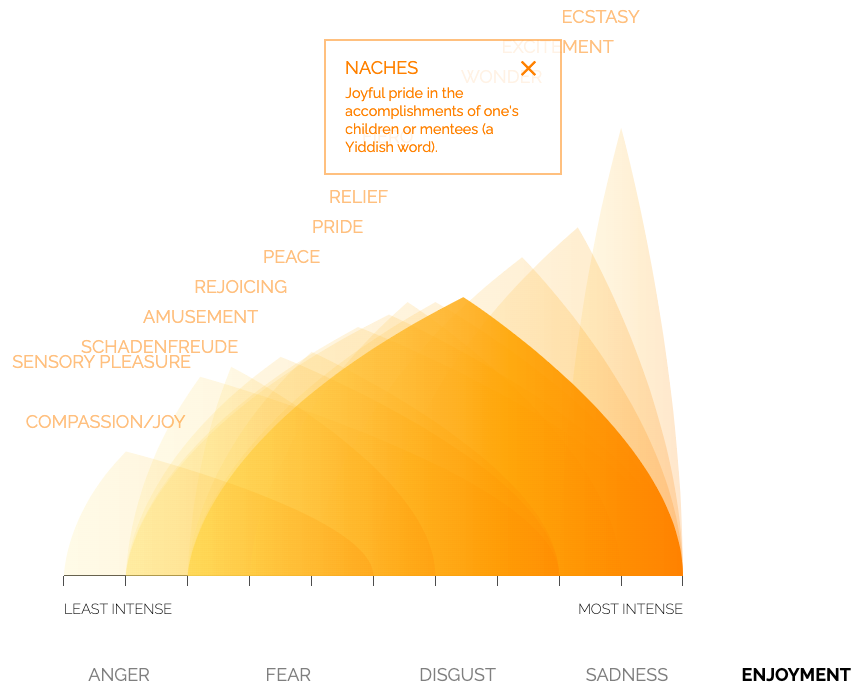
In this sense, it can be seen as a form of inner cartography: it offers a more articulated language to describe what we feel and, as a result, more tools to regulate it and understand its effects in relationships. While following a distinct path from Goleman’s model, the Atlas operates within a closely related and highly fertile terrain.
The depth of emotional intelligence
The enduring value of emotional intelligence lies precisely in its ability to hold together different levels of a dimension that often remains implicit: the influence of emotions on thought, action and relationships. In Goleman’s work, it takes the form of an operational model built on self-awareness, attentive openness and constructive practices. In everyday life, it becomes a lens for more clearly understanding what is happening, both within and around us: it helps us understand how an emotion enters a conversation, shapes a decision and either constrains or enriches a relationship. The dialogue with the Dalai Lama and the Buddhist tradition further expands this perspective, linking the analysis of emotions to a practice of observing and transforming mental states. Within this framework, the Atlas of Emotions offers a valuable tool: a map that helps us recognize reality more precisely and orient our responses. Taken together, these elements show why emotional intelligence continues to deserve attention: it is not only about what we feel, but about how we understand, process and act upon emotions in our daily lives.
References
1. Salovey, P. & Mayer, J. D. (1990). Emotional intelligence. Imagination, Cognition, and Personality, 9, 185-211.
2. Goleman D. About, Daniel Goleman
3. Destructive emotions (2000). Mind & Life Institute.
4. Mind and Life Dialogue XIII (2000). Mind & Life Institute.
5. Atlas of emotions. Paul Ekman Group.
Written by Beatrice Marzi
Edited by Marta Turchetta
Photo by Pexels