
If we look at the data on Italian generosity from the 11th Italy Giving Report by Vita, the overall picture does not suggest a crisis. Individual donations in 2024 reached €7.9 billion, marking a 72% increase over the past eleven years. Among the options donors choose to support, the nonprofit sector clearly stands out as the leading recipient: in the past year, for every euro donated to schools, 78 euros were directed to nonprofit organizations, an amount 290 times higher than the amount received by political parties.
Therefore, in Italy we are not witnessing a decline in solidarity. On the contrary, the reasons given by those who donate to the nonprofit sector reflect an intention increasingly oriented toward social transformation rather than an emotional response: the percentage of people who say they donate because it is “a way to improve society” is rising, while “guilt,” which for years fueled much of the fundraising communication, now appears among the least cited motivations.
Yet, when examining the data more closely, a tension emerges when we look at the reasons that hold Italians back from supporting nonprofit organizations. Over the past eight years, the percentage of people who say they do not donate because they oppose donations or consider them useless has significantly declined, while distrust toward nonprofit organizations has increased, becoming the primary reason for refraining from giving.1
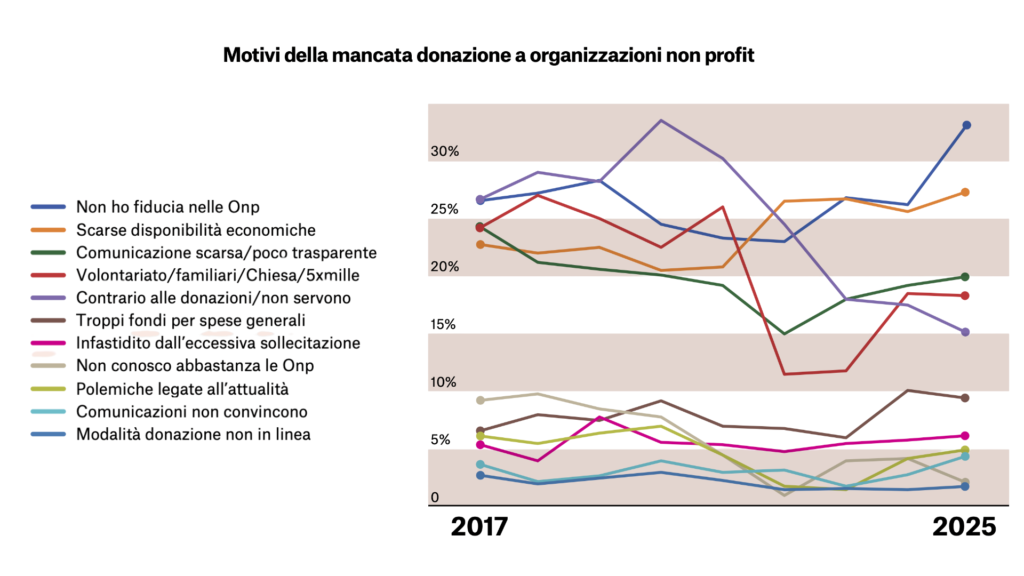
The situation is complex and requires deeper examination. How can we explain the fact that in Italy today people are donating more, and increasingly to nonprofit organizations, which widely regarded as capable of generating positive change, while trust in these same actors is declining? Are we facing a paradox, or a sign of something more profound?
Between ethics and competence
A possible answer may lie overseas, where public trust in nonprofit organizations follows a pattern similar to that of the Italian context. In the United States, nonprofit organizations are described as the “social safety net”: actors that play an essential role when other institutional actors fail to respond to collective needs2. The perception, therefore, is not far from what we observe in Italy, where the nonprofit sector is regarded as necessary and structurally relevant to the life of communities.
Despite this, between 2022 and 2025 it was nonprofit organizations in the United States that experienced the most significant decline in trust compared to other institutional actors, with a 4% decline. During the same period, small and medium-sized enterprises saw an increase in trust of 16%.
The Edelman Trust Barometer, a global survey that each year measures the level of trust people place in institutions, helps clarify the nature of this gap. According to this framework, respondents’ trust depends on the degree of ethics and competence they attribute to an institution. While nonprofit organizations are perceived more positively than businesses, government and the media in terms of ethical conduct, their performance remains weaker when it comes to competence. What is being questioned therefore is not the integrity of nonprofit organizations, but their ability to translate intentions into concrete results. In this sense, competence refers to the capacity to generate, evaluate, and communicate change effectively—meaning that the trust placed in these organizations goes beyond a simple feeling3.

From this perspective, trust functions as an invisible infrastructure: it does not appear on balance sheets, yet it significantly shapes the quality of the relationship between civil society and nonprofit organizations. If the credibility of the nonprofit sector as an actor capable of social change rests on this very infrastructure, then it becomes necessary to ask how trust is built and how it can be strengthened.
Trust as a process
To understand how this invisible infrastructure can be strengthened, it is helpful to consider trust not as a single, fixed concept, but as a process. In doing so, two terms drawn from the Pāli Canon of the Buddhist tradition can offer guidance: saddhā and pasāda.
The first, saddhā, is commonly translated as “trust” and carries a distinctive nuance: it does not denote blind adherence, but rather marks the beginning of a process. It is a form of trust that arises from listening, encountering the teaching and gradually verifying it through lived experience. Ultimately, it represents the inner disposition that orients one toward transformation: a trust that opens, that sets things in motion, that invites one to continue. The term pasāda, by contrast, evokes the dimension of clarity and a serene state of mind. In the canonical texts, this term refers to a trust that has been tested and consolidated, no longer wavering, but rooted in direct experience and mature understanding.
Read side by side, these two terms suggest a movement: from an initial trust that provides orientation and makes it possible to begin a path (saddhā), to a more mature and clarified trust, one that becomes consolidated through practice and lived experience (pasāda) 4 5.
When applied to the relationship between civil society and nonprofit organizations, this movement offers a useful interpretive lens: strengthening trust does not mean demanding immediate, unconditional trust, but rather creating the conditions under which an intentional trust—grounded in experience, transparence and demonstrated competence—can mature over time into a more stable and shared trust. It is in activating this dynamic that philanthropy can assume a decisive role, acting not only as a funder, but as an actor capable of shaping the conditions under which trust can mature.
Philanthropy grounded in intentional trust
If trust is an infrastructure, philanthropy can be one of its architects. Not only because the philanthropic sector possesses the necessary financial resources, but also because it can shape the conditions under which nonprofit organizations are able to grow, learn and demonstrate their competence.

The questions that follow are not trivial. How can philanthropy transform trust into a concrete practice capable of bringing forth the transformative potential of nonprofit organizations, without slipping into an uncritical laissez-faire stance? How can a robust principle of accountability be upheld without reducing it to a system of control that rewards compliance more than innovation and risk-taking by those working on social challenges? And, above all, is there an approach that generates value both for funded organizations and for funders, making both more effective in pursuing their respective missions?
Observing international experiences helps us untangle this knot. Studies conducted on two philanthropic grantmaking organizations that differ greatly in context and scale—African Collaborative and Yield Giving—highlight the effects of systematically applying trust-based philanthropy. Within this approach, funders provide multi-year grants and give supported organizations substantial flexibility in the use of resources, including for structural investments. The relationship is not merely financial; it is grounded in a more balanced dynamic between those who provide funds and those who receive them, oriented toward mutual learning. At the core of this philanthropic approach lies a precise assumption: nonprofit organizations are recognized as competent actors within their own contexts, and trust is granted to them as a founding act of the process.
Let us look more closely at the report Fueling Transformation by African Collaborative and examine what happens when funding for nonprofit organizations is multi-year, flexible and grounded in the recognition of local competence. Over a three-year period, supported African organizations recorded an average increase in impact of 1,125%, with emblematic cases such as Friendship Bench: by expanding its model to the USA and the UK, it grew from reaching 54,000 people to more than 925,000, demonstrated a significant structural strengthening (with operating budgets increasing by 170%) and saw 85% of its partner organizations report greater organizational resilience. The report further notes that the positive effects of this trust-based funding approach multiplied over time: for every dollar invested by African Collaborative, organizations attracted an additional $1.12 from other funders, often also unrestricted. Spending flexibility enabled investments in strategic infrastructure, internal systems, key personnel and technological innovation. In this case, trust did not lead to deregulation; it led to capacity building6.
A consistent picture emerges from the study Breaking the Mold: The Transformative Effect of MacKenzie Scott’s Big Gifts, conducted by the Center for Effective Philanthropy. The large, unrestricted gifts analyzed significantly strengthened the financial stability of recipient organizations: two years after receiving the grants, cash reserves were twice as large as those of comparable organizations, and overall spending had grown by 50%, compared to 25% among peer groups. 70% of leaders reported that the gift had substantially improved their ability to pursue their mission, while more than one third indicated a reduction in leadership burnout. Financial autonomy freed up strategic time, organizational energy, and long-term planning capacity. Contrary to the initial concerns expressed by 62% of the leaders of donor organizations interviewed, the feared “Funding Cliff” effect did not materialize—the idea that organizations would be unable to cover their core operating costs once the funds ran out. In fact, only 7% of nonprofit leaders expect to face “major difficulties” in covering future costs, and many avoided this risk by building financial reserves or endowments.
But what happens to grantmaking organizations that choose this path? Both reports show that intentional trust generates benefits not only for those receiving funds but also for those providing them. In the case of African Collaborative, the reduction of bureaucracy enabled them to allocate resources more quickly and invest in solutions rooted in local contexts, often at lower costs compared to traditional approaches. In the case analyzed by The Center for Effective Philanthropy, nearly 60% of leaders of grantmaking organizations identify time savings in application and reporting processes as one of the main operational advantages. In this instance, the role of the funder shifted from controller to strategic facilitator, with more direct access to the real dynamics of change. Trust did not create a reputational risk, but a competitive advantage: it improved operational efficiency, strengthened the impact generated and aligned invested resources more coherently with the stated mission7.
Mending the rift
Let us return to our starting point: that invisible and indispensable infrastructure called trust, which today appears fragile in Italy. Italian philanthropy now faces an important question: how much can it contribute to mending the rift between civil society and nonprofit organizations that, at times, seems worn and frayed?
If 82.5% of grantmaking organizations identify nonprofit organizations as their primary operational partners, and 30.1% acknowledge that building relationships of trust represents one of their most urgent challenges, then the issue is clearly present and deeply felt. In other words, there is awareness of the problem. The question is whether and how this awareness can translate into action capable of restoring trust.
Some data suggest that there is still room to rethink the operational practices of Italian philanthropy. Only 16.5% of grantmaking organizations consistently cover the core operating costs of funded organizations, and reporting remains strongly focused on financial and administrative aspects. This means that support tends to concentrate on individual projects rather than on the structural strength of organizations, making it more difficult for them to consolidate and demonstrate their competence over time.
At the same time, 59.2% of donor organizations report that they frequently collaborate with other philanthropic entities, indicating a significant capacity for networking and for building communities of practice. It is precisely this cooperative attitude that could become the driving force through which funding models are rethought collectively, testing and disseminating practices more oriented toward generating trust, with shared benefits for the entire ecosystem8.
Over time, philanthropy has played an innovative role in society: it has experimented, taken risks and opened paths that other actors could not or would not pursue. Today, that capacity can be placed at the service of a new challenge: innovating philanthropic practices so that nonprofit organizations are better equipped to strengthen and make visible their competence. It is in this way that trust can begin to grow again.
And every growth has a starting point. In the case of trust, that beginning coincides with the disposition of open trust we have described: an intentional trust, not naïveté but a deliberate choice to rely on others. From this initial movement, a more solid and shared trust can gradually mature over time. And perhaps it is precisely here that we may begin to mend the rift between civil society and nonprofit organizations.

References
1. De Carli, S. (2025). 11th Italy Giving Report. VITA
2. Lynch, M. G. (2025). The social safety net: How nonprofits support and contribute to our local communities in need. The Open Link
3. Doebler E., Lawson J., and Falk B. (2025). Beyond good intentions: Nonprofits must show good work to build trust. Johnson Center for Philanthropy
4. Buddhist devotion. Wikipedia
5. Buddhism. Encyclopaedia Britannica
6. African Collaborative. (2024). Fueling Transformation: The Impact of Funding African-led Innovations. African Collaborative
7. Smith Arrillaga E., Buteau, E., Im C. and Grundhoefer S. (2025). Breaking the mold: The transformative effect of MacKenzie Scott’s big gifts. Center for Effective Philanthropy
8. Osservatorio Filantropia e CSR. (2025). Dati e report
Written by Francesco Banfi
Edited by Marta Turchetta
Photo by Pexels